



By Sander Palm & Maria Tims
Organizations often rely on influence strategies to shape decisions, encourage habits, or prompt behavioral change. Whether the goal is to inspire sustainable purchases, promote healthier living, or motivate employee engagement, persuasive communication plays a central role. However, even well-crafted influence efforts can fall flat. Why? Because not every audience reacts the same way to persuasion. In many cases, ignoring individual personality differences can make influence less effective or even counterproductive.
The Classic Tools of Influence
Influence strategies are commonly built on six well-known principles by psychologist Robert Cialdini:
- Authority: People tend to follow credible experts or leaders.
- Reciprocity: Individuals feel inclined to return favors or kindness.
- Scarcity: Limited availability makes something more desirable.
- Commitment and consistency: Once someone commits to a position or behavior, they are more likely to follow through.
- Liking: We are more easily persuaded by those we find likable or similar to ourselves.
- Social Proof: People look to the behavior of others to guide their own decisions.
These tools of influence are powerful. But their effectiveness is in part dependent on the personality of the people receiving the message.
Why Personality Matters
Every individual has a unique combination of personality traits. The most widely used model for understanding these traits is known as the Big Five, which includes:
- Openness to experience: Reflects curiosity, imagination, and preference for variety.
- Conscientiousness: Describes organization, responsibility, and goal orientation.
- Extraversion: Represents sociability, energy, and enthusiasm for interacting with others.
- Agreeableness: Involves kindness, cooperation, and sensitivity to others.
- Neuroticism: Indicates emotional sensitivity, anxiety, and a tendency to experience stress.
These traits help determine how people process information, make decisions, and respond to influence.
The Risk of Getting It Wrong
When influence strategies do not match the audience’s personality traits, the outcome can be disappointing. This is especially problematic in high-stakes areas like health behavior, financial decisions, or employee performance. In some cases, a mismatch between an influence strategy and personality traits can even backfire and be counterproductive.
This mismatch between influence strategies and personality is what makes generic campaigns risky. It is not enough to apply a proven principle. The key is to understand who the message is for and how they are likely to interpret it.
How Personality Shapes Processing
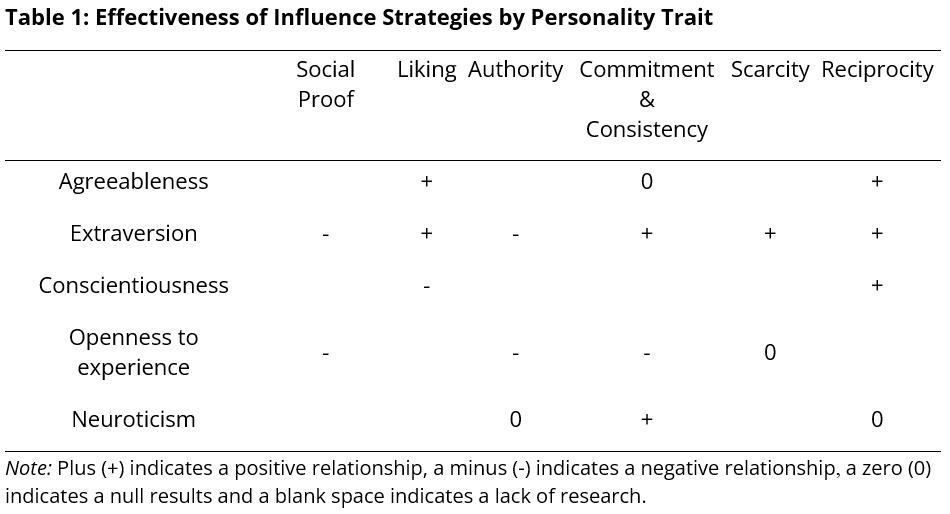
Our review of 80 articles ranging from 1982 till September 2024 presents an outline of effective influence strategies for each personality trait within the Big Five model, indicating variations in the effectiveness of distinct influence strategies across traits.
- Openness to experience: Individuals high in openness do not align neatly with any particular influence strategy. While strategies such as social proof, liking, commitment and consistency, and authority tend to have less impact on them, a strategy like scarcity shows slightly greater effectiveness. The curiosity that defines this personality trait appears to show an inclination to be persuaded by their own volition.
- Conscientiousness: Those scoring high in conscientiousness respond strongly to the influence strategy of reciprocity. Their reliability is deeply intertwined with a heightened sense of duty and obligation. Reciprocity appeals to this sense of responsibility, effectively motivating conscientious individuals to act in kind.
- Extraversion: Extraverts are responsive to a range of influence strategies, particularly liking, commitment and consistency, scarcity, and reciprocity. Interestingly, despite their outgoing and social nature, social proof and appeals to authority tend to be less influential. This may stem from their expansive social networks and preference for personal, direct interactions rather than deference to status or group consensus.
- Agreeableness: Liking emerges as a key strategy for persuading agreeable individuals. Their inclination toward kindness, empathy, and cooperativeness makes them naturally responsive to gestures of goodwill and mutual exchange.
- Neuroticism: People with higher levels of neuroticism are most influenced by commitment and consistency. Given their tendency toward distrust and emotional volatility, they often prefer to adhere firmly to their initial decisions or beliefs, making consistency a powerful lever in shaping their behavior.
The findings indicate that matching influence strategies with personality traits instead of one-size-fits-all strategies creates an opportunity to improve their effectiveness on influencing individual behavior (see Table 1).
A Smarter Approach to Influence
Leaders, marketers, and policymakers can improve results by taking a more tailored approach to persuasion. Here are three steps to make influence strategies more effective:
- Understand your audience’s personality.
Gather insights through surveys, behavior patterns, or digital interactions. The more you know about how people think, feel and behave, the more likely that you pick the right influence strategy. - Identify how susceptible your audience is to influence strategies.
In addition to influencing what types of messages people respond to, personality also affects how susceptible they are to influence strategies. Among the Big Five personality traits, individuals high in agreeableness demonstrate the greatest susceptibility to influence strategies, whereas those scoring high in neuroticism tend to be the least likely to be influenced. - Match the right message to the right audience.
Some groups respond strongly to reciprocity, while others prefer appeals to scarcity. Understanding these tendencies helps you select the right influence strategy. If you don’t have the option the use different messages, choose the approach that resonates most broadly without pushing others away.
Influence with Precision
Organizations that take the time to understand the personalities of their audiences will be better equipped to create influence. Rather than applying one-size-fits-all strategy, the most successful campaigns will tailor their approach to the personality of their audiences. A strategy that motivates one person can demotivate another. Understanding personality helps to increase the chances that strategies have influence. If influence efforts are to succeed, they must begin with a simple but important question: Who are we trying to persuade?

Sander Palm is a program manager at The Hague University of Applied Sciences and PhD candidate at the VU Amsterdam. He is passionate about what drives human behavior and how people make decisions, and he is the co-author of the book Golden Behaviors. As a behavior change and personality expert, it's his mission to create new insights in the world of behavioral science and make them available to organizations and people by translating it to everyday life.

Maria Tims is a full professor at the VU Amsterdam and holds a chair in the Future of Work Design. Her scientific and practical expertise lies in the areas of employee proactivity and work design, at the individual and team level, such as self-organizing teams, and employee well-being and performance. Maria measures and facilitates the development of employee proactivity (e.g. job crafting) as most work environments now call for proactive employees who take action to change things when needed.